
Shilajit is a unique natural substance that has been used in traditional Ayurvedic practices for centuries. The very existence of this curious consistency and the fact that it comes from nature sets it apart from ordinary herbs and medicinal plant materials.
But what is Resin, exactly? How is this substance formed? What properties does it have? What benefits does it provide?
In this article, you will learn 7 things about Shilajit resin that you didn’t know before. From how the formation process works to modern Resin supplements – we’ll take a look at the key points.
What Is Shilajit?
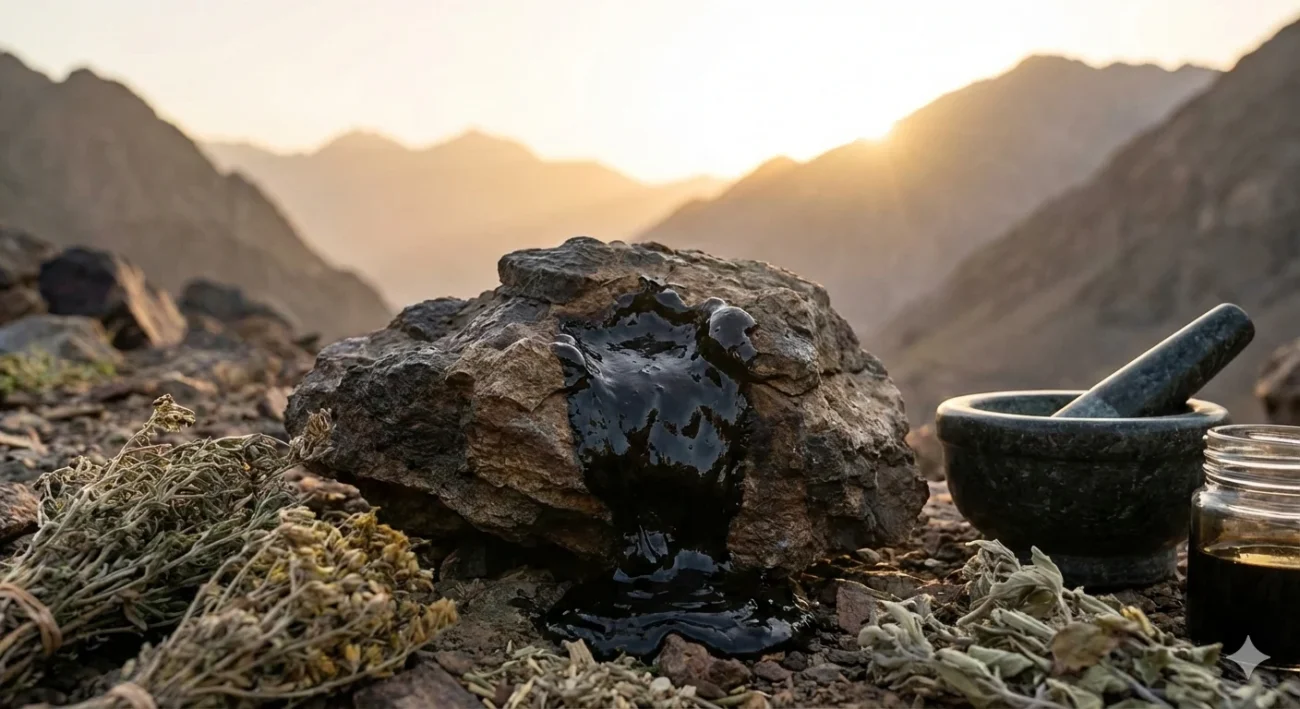
Shilajit is a naturally occurring organic-mineral or herbomineral substance, which is a dark brown to blackish material, found in mountainous regions that often takes the form of a sticky and resinous exudate, which is found exiting from rock fissures and layers
It is traditionally associated with the Himalayan and other high-altitude mountain regions. Shilajit has been described in scientific literature as a complex mixture containing humic substances, organic compounds and minerals.
It has a long history of use in Ayurvedic and traditional medicine, where it has traditionally been described as a Rasayana or rejuvenating substance.
Is Shilajit a Plant? Is It Grown?
One of the most frequent questions regarding Shilajit is about whether it is cultivated or not.
Natural Shilajit is not a plant or herb. It does not grow like a crop.
It is not cultivated or farmed like Ashwagandha, Tulsi, or most herbs.
Instead, it is found naturally in mountainous rocky areas. Researchers believe that certain organic and plant material and bacteria may be responsible for the creation of Resin, over immense periods of time. However, the natural formation process and origin of Resin is still debated and is not fully known.
A simplified way of understanding the process is:
Plant & Organic Matter → Decomposition → Microbial Transformation → Geological Processes → Resin
This is a natural process that occurs over a long period rather than a conventional agricultural process.
How Is Shilajit Formed?
The formation of shilajit is complicated.
It can form when plant material and other organic matter gets trapped or accumulates in mountainous areas. Microorganisms can also break down and contribute to the formation of this organic matter.
The mineral content, temperature, pressure, moisture and the surrounding rock environment can all effect the characteristics of the material.
Various scientific studies have provided various theories about the origins of Resin, which is not completely understood.
This long forming process is one primary reason why Resin is so drastically different from a regular herbal extraction.
What Does Shilajit Contain?
Resin is a complex natural material rather than a single chemical compound.
Research has identified several types of substances in Resin, including:
- Humic substances
- Fulvic compounds
- Minerals
- Amino acids
- Organic acids
- Plant-derived compounds
- Other naturally occurring bioactive compounds
The exact composition can vary depending on the geographical source and processing method. A comprehensive review found substantial differences in chemical composition between Resin samples from different regions. This geographical variation is important when considering the quality and consistency of Shilajit products.
How Is Shilajit Used in Modern Supplements?
Natural Resin is rarely taken as it is, straight from the rock. The commercial products often process the material in order to extract the useful particles and use it in powder, resin or capsule form.
The processing usually goes as follows:
harvesting → cleaning → purification → formulation → encapsulation → packaging
Depending on the producer, the process may vary. So, it is better to read the ingredients list of a particular Resin capsule you are going to buy in order to see what is in it exactly. Not all the products contain Shilajit resin as the main ingredient. Some of them may include other herbs or minerals.
Therefore, it is essential to pay attention to the percentage of Shilajit in the capsule and the additional substances it contains.